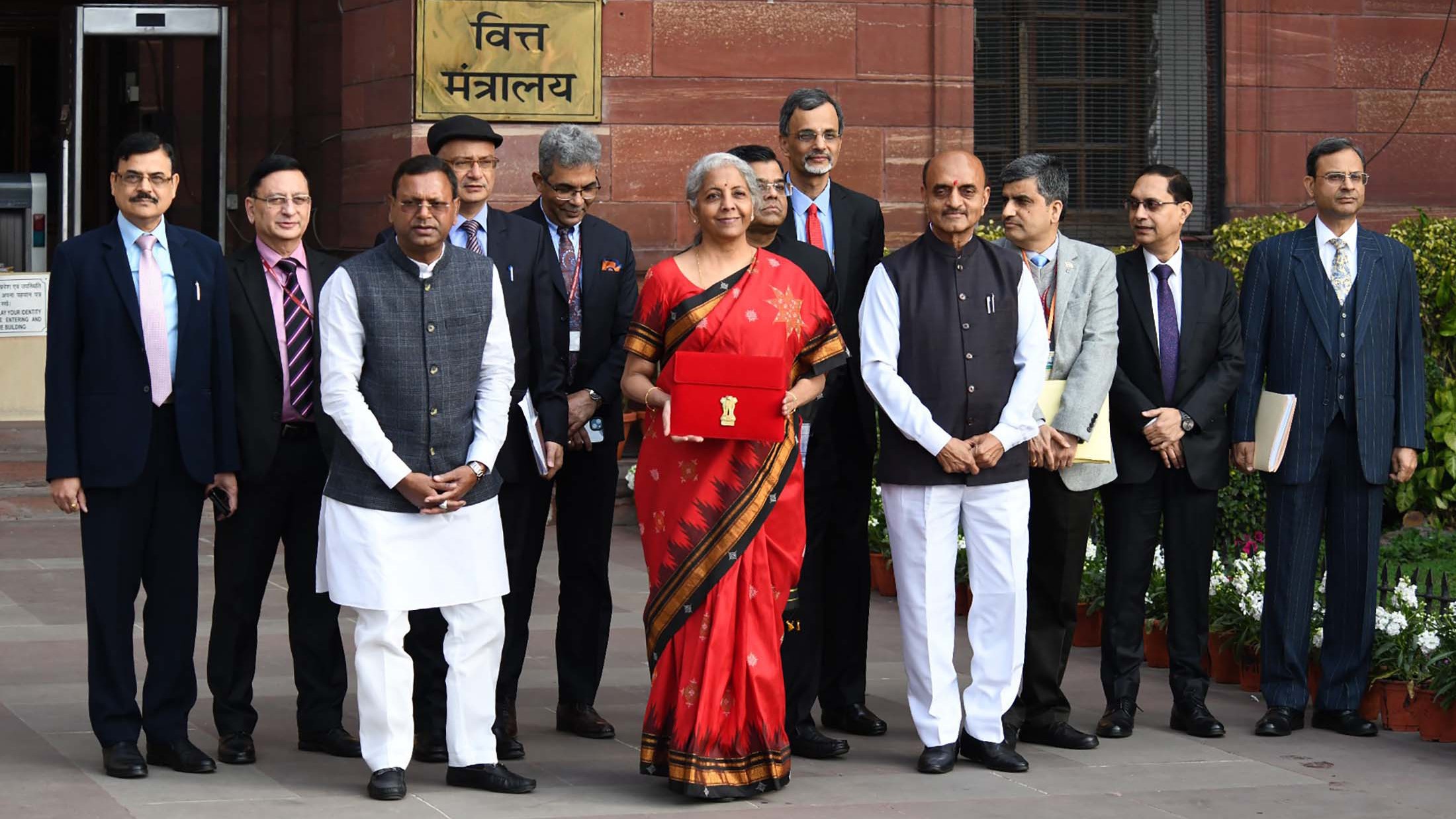
Union Finance Minister Nirmala Sitharaman presented her ninth consecutive Union Budget 2026-27 on February 1, 2026, becoming the first Finance Minister to do so.
The Union Budget is inspired by the ‘3 Kartavyas’ (duties) — namely, economic growth, fulfilling aspirations, and inclusive participation.
It rightly focuses on capital expenditure (Capex), manufacturing, and fiscal consolidation, which shows the government’s commitment to inclusive and developmental growth.
Key Financial and Fiscal Metrics
The government remains committed to fiscal discipline while increasing public spending to drive the economy, which is the need of the hour. Let’s delve into it one-by-one.
- Fiscal Deficit
The Revised Estimate of Fiscal Deficit (FD) stands at 4.4 percent of GDP for Fiscal Year (FY) 26 – which is the same as the Budget Estimates. The FD target for FY27 has been set at 4.3 percent of GDP.
- Capital Expenditure
The Capex has increased by 8.99 percent (8.985 percent exactly) to 9 percent to a record ₹12.2 lakh crore for FY 27 to sustain infrastructure momentum.
- Total Expenditure
The Total Expenditure is estimated at ₹53.5 lakh crore, a 10.2 percent increase over the previous year’s Budget Estimates (i.e. BE 2025-26). The total expenditure includes ₹12.22 lakh crore dedicated specifically to capital expenditure to drive long-term infrastructure growth.
- Gross Market Borrowing
The government will raise a record of ₹17.2 lakh crore from the markets through dated securities. This is an increase of 8.9 percent in comparison with the ₹15.8 lakh crore originally planned (BE) for the previous year.
This higher-than-expected figure is primarily driven by the need to repay approximately ₹5.5 lakh crore in maturing old debt. This means after the repayments of maturing debt, the Net Market Borrowing is pegged at ₹11.7 lakh crore to fund the fiscal deficit.
- Tax Revenue
On the Source of Income, the government has set a Gross Tax Revenue target of ₹44.04 lakh crore, which is a 14.95 percent growth over the FY26 BE.
Among these, income tax has a BE of ₹14.66 lakh crore for FY27, an increase by 1.95 percent compared to last year’s BE, and Corporation Tax has increased by 13.8 percent, with a BE of ₹12.31 lakh crore for FY27.
Of the other components of Tax Revenue, customs duty is estimated at ₹2.71 lakh crore, with an increase of 17.31 percent (compared to last year’s BE) and GST is estimated at₹10.19 lakh crore with an increase of 11.12 percent over the FY26 (i.e. BE 2025-26).
- Non-Tax Revenue (RBI Dividend)
On the Non-Tax Revenue side, a significant portion of funding comes from profits and dividends. The BE shows a record ₹3.16 lakh crore transfer from the RBI and Public Sector Banks. This is with a significant increase of 23.4 percent over the previous year’s original BE 2025-26 of ₹2.56 lakh crore. This substantial amount will provide a fiscal cushion.
- Interest Payments
The interest payments are estimated at ₹13.64 lakh crore (to be precise, ₹13,63,649 crore) with an increase of 14.55 percent, in comparison to the BE of ₹11.9 lakh crore in FY26.
- Subsidies
The total subsidy is budgeted at ₹4,42,834 crore for FY27, which is an increase of 16.18 percent over the BE of ₹3,81,175 crore in FY26.
Among these, food subsidy is estimated at ₹2,27,629 crore for FY27, with an increase of 10.9 percent over the BE of ₹2,05,250 crore in FY26. Fertiliser subsidy has increased by 4.1 percent with a BE of ₹1,70,805 crore for FY 27, in comparison to a BE of ₹1,64,000 crore in FY26.
By decriminalising some procedural infractions, such as failing to produce books, and combining evaluation and penalty procedures into a single order, the budget reflects a shift towards ‘Trust-Based Governance.’
Strategically, the goal of making India a global data hub is highlighted by the tax break for foreign cloud service companies using Indian data centres till 2047.
Conclusion: The Balancing Act
As the global markets are looking at India, the Union Budget 2026-27 navigates the fiscal landscape in a sophisticated manner that may have even stunned international observers.
But the true test of this vision lies in execution. By keeping the Fiscal Deficit budgeted at 4.3 percent and increasing Capex by 8.99 percent (to ₹12.22 lakh crore), the government has shown its strong commitment to fiscal prudence and long-term asset creation. The ‘balancing act’ is almost successful.
However, a closer look reveals several puzzling factors. A worrying fragility is hidden beneath these steady numbers: household debt is increasing while savings are decreasing. The Net Financial Savings have fluctuated to lows of 3-4 percent of GDP in recent quarters, suggesting that rising household debt needed to sustain consumption is offsetting the growth in savings.
By not offering tax breaks or incentives for conventional bank deposits, the Budget runs the risk of causing a liquidity crunch in the banking industry, leaving the government’s record ₹17.2 lakh crore borrowing to compete for a diminishing capital reserve.
The lack of strong domestic savings forces the government to rely even more on Foreign Portfolio Investment (FPI) and the ₹3.16 lakh crore RBI dividend, making the economy increasingly vulnerable to global shocks.
The Budget relies on a 15 percent tax growth promise to keep the Fiscal Deficit of 4.3 percent alive, even as nominal GDP growth is estimated at a more modest 10.5 percent.
A major portion of market borrowing will be consumed by ₹5.5 lakh crore old debt, leaving the Net Market Borrowing at only ₹11,7 lakh crore. This is evidenced by the record interest payment bill of ₹13.64 lakh crore, which outpaces the entire Capex outlay.
With a record ₹3.16 lakh crore dividend from the RBI and Public Sector Banks, the non-tax revenue side, fortunately, offers a crucial buffer.
Record sectoral expenditures in defence and railroads are crucial indicators of narrative leadership, but the highest debt-servicing bill in history still constrains the actual fiscal capacity to use these funds.