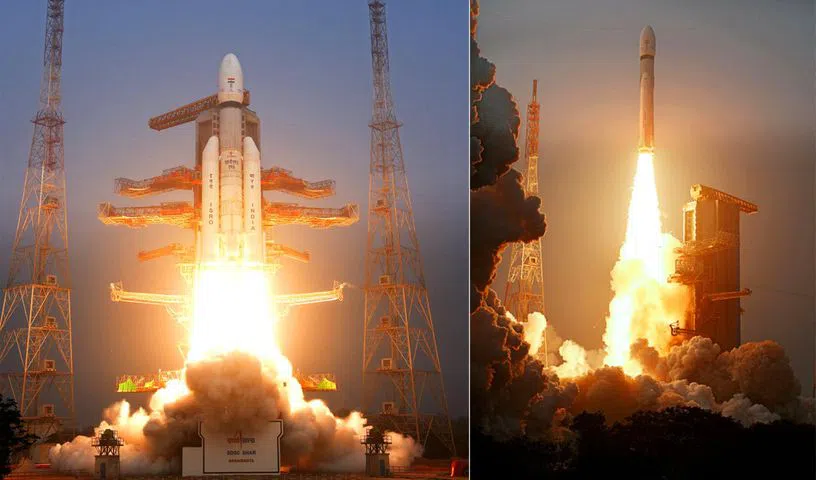
Sriharikota: India’s space programme reached a historic high on Wednesday as the Indian Space Research Organisation (ISRO) successfully launched its heaviest-ever payload from Indian soil, reinforcing the country’s growing stature in the global commercial space market.
The LVM3-M6 heavy-lift rocket soared into the morning sky at 8:55 am from the Second Launch Pad at the Satish Dhawan Space Centre, Sriharikota, carrying the BlueBird Block-2 satellite into its intended Low Earth Orbit (LEO).
Weighing an unprecedented 6,100 kg, the satellite is the largest commercial communications spacecraft ever deployed in LEO.
A record-breaking mission
Standing 43.5 metres tall, the LVM3 — popularly known as ‘Bahubali’— has now demonstrated its highest payload-carrying capability to date. This sixth operational flight of the LVM3 marks a significant leap from its previous benchmark, when it carried a 4,400 kg satellite during the LVM3-M5 mission in 2024.
ISRO confirmed that BlueBird Block-2 was successfully injected into orbit about 15 minutes after liftoff, at an altitude of approximately 600 km, marking the heaviest payload ever launched by India into Low Earth Orbit.
Engineering excellence, made in India
The LVM3’s three-stage configuration highlights India’s indigenous launch vehicle capabilities:
- Two S200 solid rocket boosters provide the massive thrust at liftoff
- A liquid-fuelled L110 core stage ensures sustained propulsion
- A high-performance cryogenic upper stage, developed in India, enables precise orbital insertion
Together, these systems underline ISRO’s maturity in heavy-lift launch technology — an area once dominated by only a handful of spacefaring nations.
A ‘cell tower in space’
Developed by US-based AST SpaceMobile, the BlueBird Block-2 satellite represents a breakthrough in space-based communications. Equipped with a 223-square-metre phased-array antenna, it functions as a cell tower in space, enabling direct-to-mobile connectivity.
Unlike conventional satellite services, the technology allows ordinary smartphones — without any special hardware — to connect directly for:
- 4G and 5G voice and video calls
- Text messaging and data services
- High-speed internet access, even in remote or underserved regions
The satellite is part of AST SpaceMobile’s global LEO constellation aimed at bridging connectivity gaps for nearly six billion mobile users worldwide, including during natural disasters and emergencies.
Strengthening India’s commercial space role
The mission was executed under a commercial agreement between NewSpace India Ltd (NSIL) — ISRO’s commercial arm — and AST SpaceMobile, marking a milestone in India-US collaboration in space technology.
Prime Minister Narendra Modi hailed the launch as ‘a proud milestone in India’s space journey,’ stating that it strengthens India’s heavy-lift launch capability and reinforces its role in the global commercial launch market.
Union Minister of State for Science and Technology, Jitendra Singh, also praised ISRO’s scientists and engineers for yet another landmark achievement.
Looking ahead
With this flawless mission, ISRO has not only expanded the operational envelope of the LVM3 but also sent a strong signal to the global space industry: India is ready to handle the world’s heaviest and most complex commercial payloads.
As demand for satellite-based broadband surges worldwide, Wednesday’s launch firmly positions India as a reliable, cost-effective, and technologically advanced partner in the rapidly evolving space economy.