
Bengaluru: In an era marked by widening executive pay gaps and growing scrutiny of corporate governance, Infosys founder N.R. Narayana Murthy delivered a powerful reminder of what ethical leadership truly means: “Leaders eat last.”
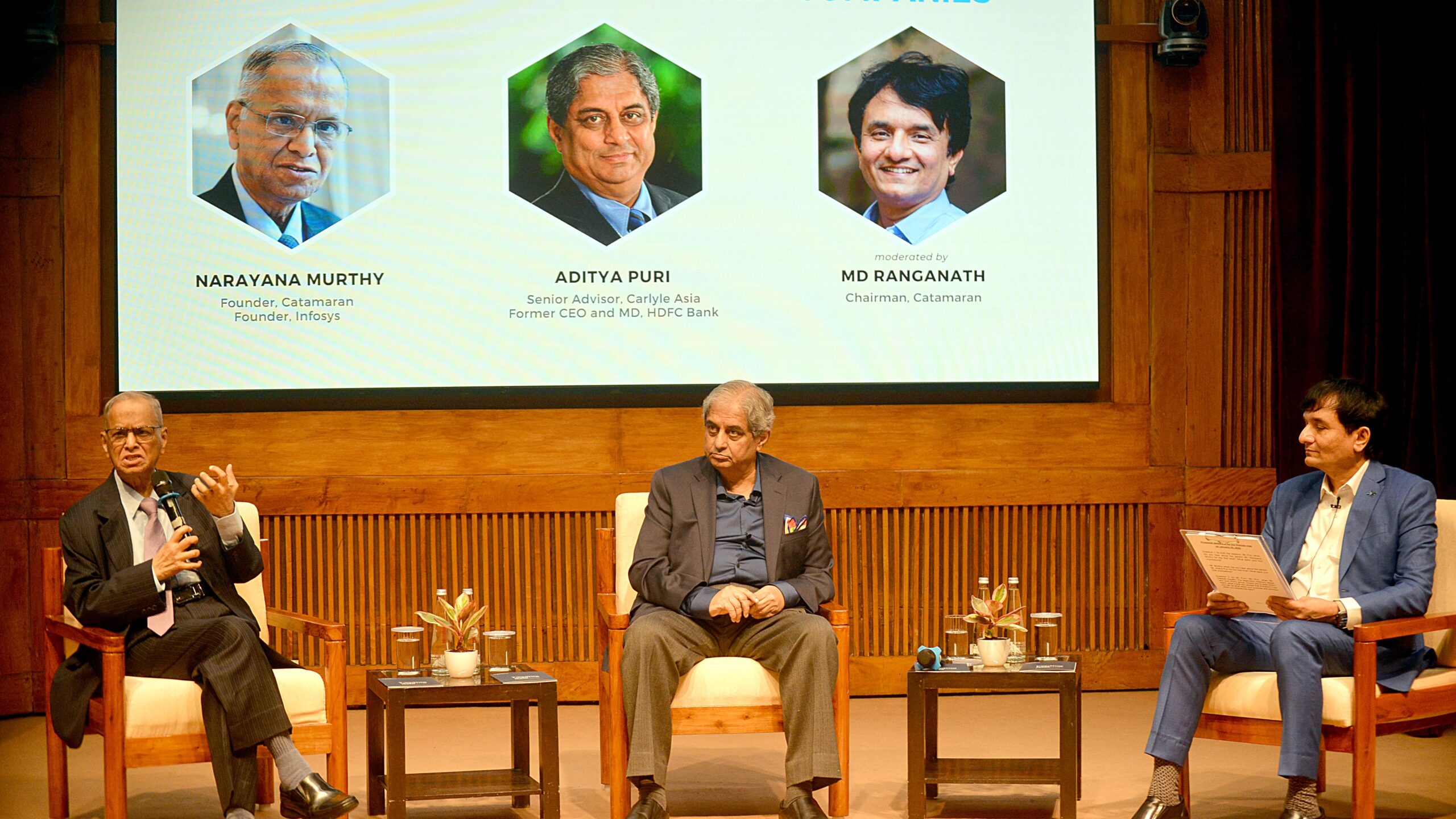
Speaking at a rare fireside chat at IIM-Bangalore, Murthy urged corporate leaders to place employee welfare, fairness, and long-term value creation above personal enrichment.
The session, moderated by M.D. Ranganath, Chairman of Catamaran Ventures, featured an engaging exchange between Murthy and Aditya Puri, former CEO and MD of HDFC Bank — two icons whose leadership journeys have shaped modern corporate India.
“You should be the last person to obtain benefit from the company — only after every employee has gotten it,” Murthy said, underlining his belief that leadership was a responsibility, not a privilege.
Beyond Pay: Living the Values
For Murthy, the issue of executive compensation goes far beyond salary figures. True leadership, he said, demands visible and consistent adherence to organisational values. “In order to keep the memory fresh of the values of the organisation, the leader has to demonstrate his or her commitment to those values from time to time,” he noted.
Recalling Infosys’s formative years, Murthy highlighted the company’s strong emphasis on broad-based wealth creation, particularly through employee stock ownership.
Infosys, he said, distributed stock options at an unprecedented scale in India —benefiting employees across all levels. “The then value of the stock options we provided was $19 billion on a market capitalisation of about $60 billion —almost 30 percent to employees. The best peon, the best clerk, the best accountant, the best software manager — everyone benefited,” he said.
Trust as the Ultimate Asset
Murthy stressed that leadership accountability extends to all stakeholders, especially minority shareholders. Leaders who misuse shareholder trust, he warned, fail not only as professionals but as human beings.
“A minority shareholder puts her hard-earned money in your company. If you lead a profligate life and blow it up, you’re not a great human being,” he said.
In a generous tribute, Murthy described Aditya Puri as “India’s finest entrepreneur post-Independence,” drawing a contrast between their respective journeys. “Infosys focused on revenues outside India; he succeeded in the Indian environment,” Murthy said, pointing to the scale achieved by HDFC Bank. “Infosys is at about $70 billion in market cap, while HDFC is at $180 billion.”
Puri, in turn, reflected on Murthy’s global reputation. “I heard about him when I was working in Malaysia,” he said, adding that Murthy’s example inspired him to return to India and build an institution grounded in trust and discipline.
Emphasising financial clarity and integrity, Puri summed up his philosophy succinctly: “There is no EBITDA or adjusted EBITDA. You’re either profitable or you’re not.”
A timeless leadership lesson
Together, Murthy and Puri offered a compelling blueprint for leadership — one rooted in fairness, values, and accountability. At a time when corporate India is redefining its priorities, their message resonated clearly: true leaders put people first, safeguard trust, and let success follow — not the other way around.