

The Foreign Direct Investment (FDI) landscape has been evolving over the past few years, with India being one of the favourite destinations (15th rank) for FDI. This may be attributed to the FDI policies evolving over the years to boost the country’s investment appeal.
The following information was provided by Minister of State for Commerce and Industry, Jitin Prasada, in a written reply in the Lok Sabha on 2 December 2025.
To attract more investment and to make India a favourable destination for investors, the Government of India continuously reviews its FDI policies.
It focuses on improving the business environment by streamlining processes, upping logistics, improving infrastructure and removing regulatory barriers.
To promote healthy competition among states to attract more investment, including FDI, various initiatives like the Business Reforms Action Plan (BRAP) and the Logistics Ease Across Different States (LEADS) report have been implemented.
Transformative reforms have been undertaken by the Government of India in various sectors such as Defence, Insurance, Pension, Construction, Civil Aviation, and Single Brand Retail Trading, to liberalise FDI norms.
These significant reforms carried out between 2014 and 2019 increased FDI in the aforesaid sectors.
The government also took an important measure, between 2014 and 2019, to allow 100 percent FDI under the Automatic Route in insurance intermediaries, coal mining and contract manufacturing.
To promote more foreign investment, the FDI policy’s requirements have been gradually liberalised and streamlined across a number of industries. Recently, significant reforms were carried out in industries such as defence, insurance, telecom, petroleum and natural gas, and space.
To make the process more effective and responsive to investor needs, the government has streamlined tax compliance and investment promotion for international investors.
In 2024, the Income Tax Act of 1961 was amended to reduce income tax rates for foreign corporations and to abolish the angel tax.
The GST changes implemented in September 2025 aim to boost entrepreneurship and job creation in industries with high youth participation.
The streamlined GST structure with lower rates in sectors such as leather, footwear, textiles, and logistics will benefit businesses, startups and ease compliance for traders.
Free Trade Agreements (FTA) have been utilised to boost export diversification and attract investments, with agreements like the one with the European Free Trade Association (EFTA) securing substantial investment commitments.
The current FDI policy in India allows up to 100 percent FDI in most sectors through the Automatic Route, with certain conditions. FDI has played a crucial role in India’s development by bringing in financial resources, technology transfers, and creating employment opportunities.
FDI growth in FY 2024-25 and FY 2025-26
During the first half of Financial Year 2025-26, there is seen an increase of 16 percent in total FDI inflow (provisional data) compared to the same period in previous years.
FDI has reached US$50.36 billion, the highest ever in the first half of the financial year. In FY 2024-25, FDI inflow reached US$80.62 billion, the highest in the last three years.
The FDI cap has been increased in a number of industries due to recent policy changes. The Automatic Route currently permits up to 74 percent FDI in the defence sector, up from 49 percent, for businesses applying for new industrial licences.
While the insurance sector’s FDI quota has been increased from 49 percent to 74 percent under the same route, the telecom sector permits 100 percent FDI under the Automatic Route.
FDI inflows have been substantial since these sectors were liberalised. Until FY 2024–2025, FDI inflows into the Defence, Insurance and Telecommunications sectors totalled US$11.59 million, US$ 8,788.59 million, and US$1,740.81 million, respectively.
There is a significant increase in FDI during FY 2024–2025 relative to their respective liberalisation years. Several industries have demonstrated strong performance post-reform.
What does FDI data from DPIIT say?
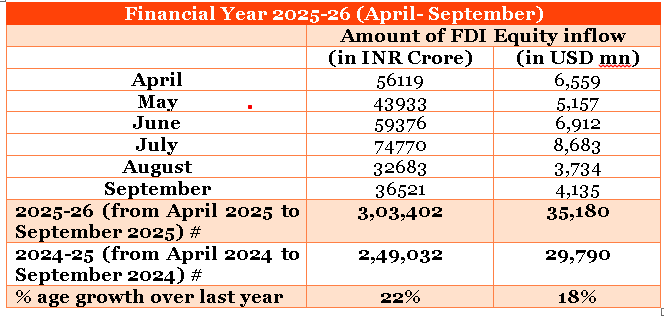
According to the Department for Promotion of Industry and Internal Trade (DPIIT), during the present FY 2025-26, FDI has increased by 18 percent (Year-on-Year). However, this is comparatively lower than the corresponding period of the last FY 2024-25, which witnessed a 27 percent increase in FDI.
The following table shows FDI inflow (month-wise) during FY 2025-26.
Note: i) Country and Sector-specific analysis is available from the year 2000 onwards, as remittance-wise details are provided by RBI from April 2000 onwards only.
- ii) Figures are provisional, subject to reconciliation with RBI, Mumbai.
Source: FDI Statistics, DPIIT
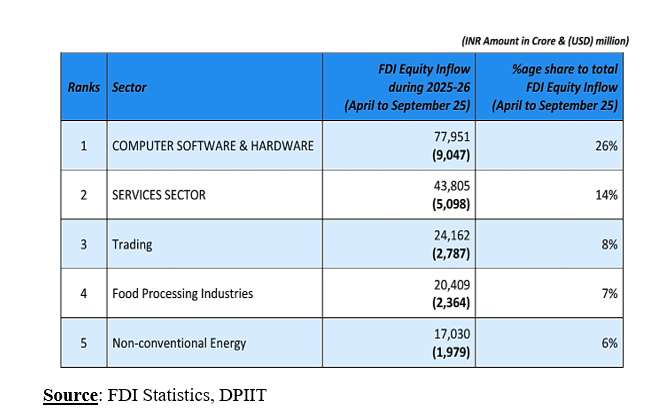
The computer software and hardware sector took the top five percentage share of total FDI equity inflow with 26 percent, followed by the service sector with 14 percent in FY 2025-26.
The following is the share of top five sectors attracting the highest FDI equity inflow:
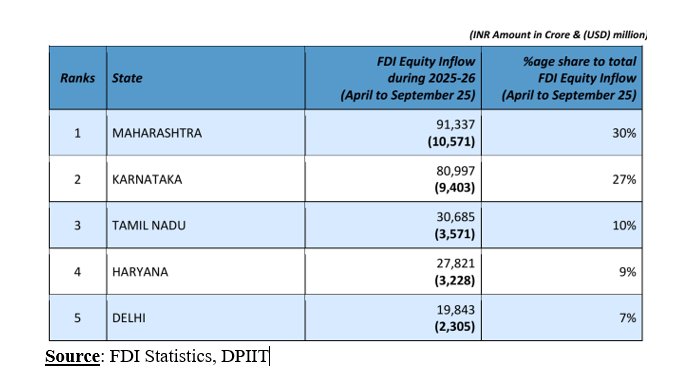
Maharashtra tops among states in attracting 30 percent of total FDI, followed by Karnataka with 27 percent in FY 2025-26. Here is the share of top five states attracting the highest FDI equity inflow:
FDI has witnessed a roller-coaster ride since 2016; however, for the past two years, it has been slowly in ascending mode – owing to consistent reforms which are making India a more attractive destination for investors.