India’s capital expenditure in H1 FY26 shows robust growth in key infrastructure sectors, with road, railways and defence leading the charge. However, fiscal pressures remain evident in the broader expenditure trends.
The Union Budget for 2025-26 announced a capital expenditure of ₹11.21 lakh crore, a 10 percent increase from the previous year, aimed at boosting infrastructure and economic growth.
Additionally, there is a provision of ₹1.5 lakh crore for interest-free loans to states for capital expenditure and reform incentives. India’s fiscal strategy in the first half of FY26 has been marked by aggressive capital expenditure, particularly in infrastructure and defence.
In this article, we are going to analyse the total expenditure and capital expenditure of the Union Government (till September 2025 – as provided on the Controller of General Accounts’ website) for the fiscal year 2025-26.
Total expenditure and capex surge in fiscal 2025-26
The ministries of Road Transport and Highways and Railways have exceeded the national average capital expenditure (capex) by spending 63 percent and 57 percent of the Budget estimates (BE) in the first half of FY26. The total capital expenditure for April-September of FY26 was at 52 percent of the BE.
The increased capex spending includes ₹50,000 crore disbursed to the Department of Food and Public Distribution against a budget allocation of ₹20 crore for FY26.
Excluding this amount, the government’s total capital expenditure for the first half of FY26 has increased and stood at 47.3 percent of the BE. An analysis of ministries with a minimum allocation of ₹3,000 crore under capex revealed that the Petroleum and Natural Gas ministry and the Department of Economic Affairs lagged, utilising only 2 percent of their capex in H1.
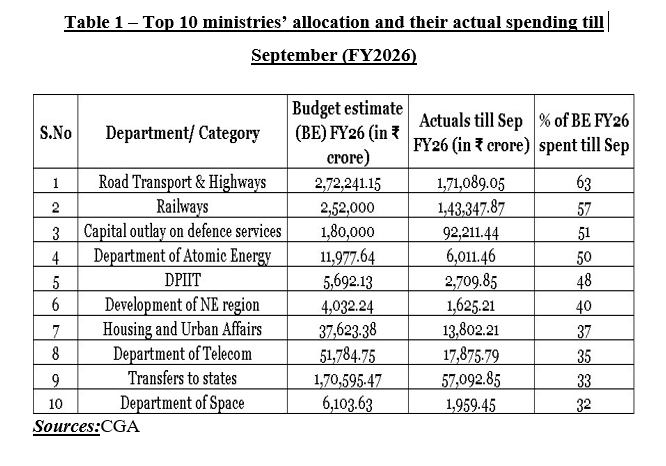
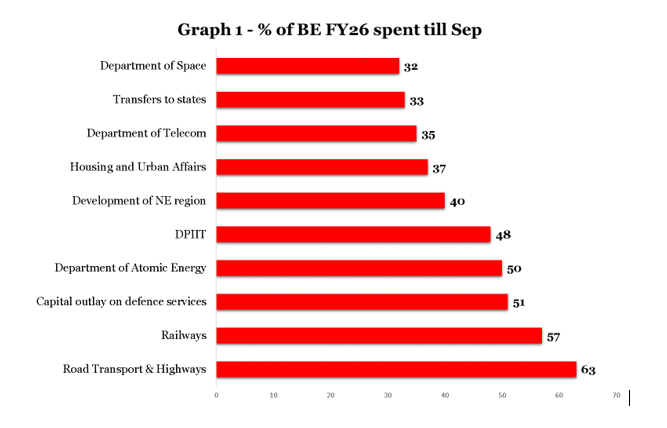
The Department of Science and Technology did not utilise its ₹20,096 crore capex allocation, as per CGA data.
Data from the Controller General of Accounts (CGA) reveals a nuanced picture, where overall capital expenditure for April-September FY26 increased by 40 percent compared to the previous year, reaching ₹5.81 trillion, exceeding the budgeted growth of 6.6 percent.
Revenue expenditure accounted for ₹17.23 trillion, suggesting that while infrastructure spending is prioritised, routine administrative and welfare costs still dominate the fiscal landscape.
The fiscal deficit stood at ₹5.73 trillion, which is approximately 25 percent (24.88 percent) of the total expenditure and 36.52 percent of the Budgeted Fiscal Deficit, but still demanding caution.
Tax revenue collections were healthy, with gross tax revenue at ₹12.29 trillion, driven by strong direct tax performance.
Views of economists and the FM
Experts believe that the government may be cautious in capex spending due to revenue pressure from GST collections shortfall, but private sector investment is expected to rise with improving consumer sentiment.
Despite increased defence spending, the fiscal deficit remains manageable, with a slight risk of slippage.
Economists anticipate the government will achieve the fiscal deficit target of 4.4 percent by adhering to the plan, as capex is discretionary spending. The Finance Minister of India has expressed confidence in meeting the fiscal deficit goal before shifting focus to the debt-to-GDP ratio in the next fiscal year.
Conclusion
Prioritising capital expenditure and fiscal deficit targets is crucial for any government.These two factors are key to understanding the government’s workings and its initiatives.
Some ministries show increased capital expenditure in the first half of the year (H1), whereas others have yet to begin spending in this area.
Achieving the fiscal target is the priority of the government, as seen in the Finance Minister’s statement.
To summarise, India’s financial performance in the first half of fiscal 2026 highlights a shift towards growth that relies heavily on investment, especially in the transport and defence sectors.
This is a good sign for the economy’s future, but it’s important to find the right balance between responsible spending and the desire for progress.
The key to maintaining this progress is strong revenue, controlled spending, and macroeconomic stability.