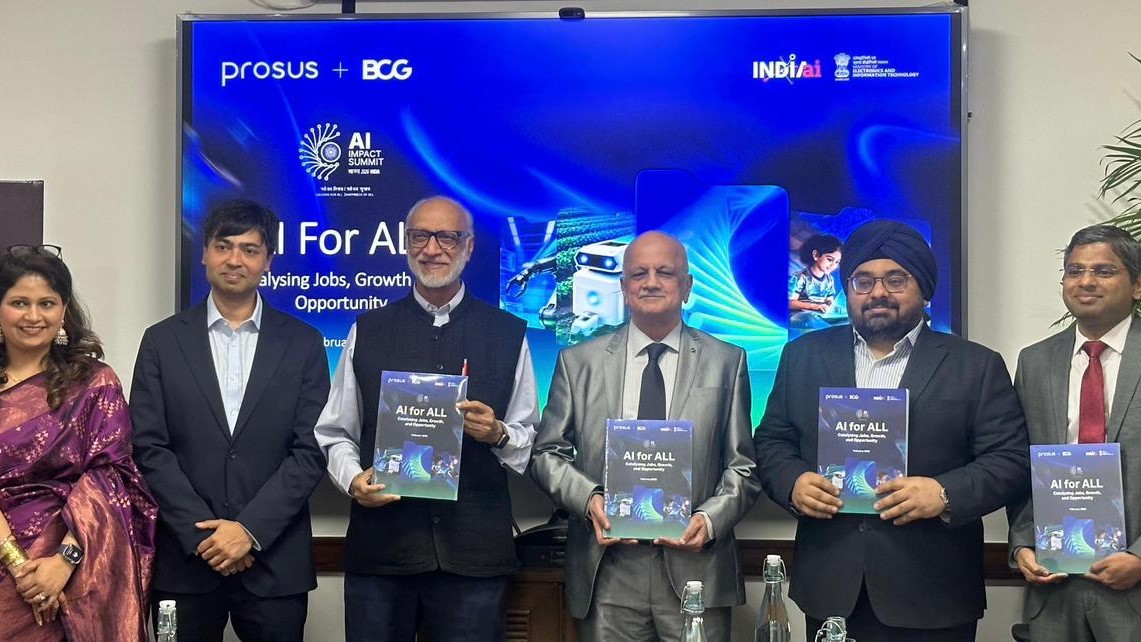
New Delhi: At a defining moment in India’s growth trajectory, Prosus, a global technology company, in partnership with knowledge partner BCG and the Ministry of Electronics and Information Technology (MeitY), Government of India, recently launched the “AI for All: Catalysing Jobs, Growth, and Opportunity” white paper at the India AI Impact Summit 2026 in New Delhi.
The initiative marks a strategic effort to shift the national AI narrative from a narrow focus on automation and displacement to one centred on productivity expansion, institutional strengthening and equitable participation in the digital economy.
The report was formally released by Euro Beinat, Global Head of AI, Prosus, David Tudor, General Counsel, Prosus and Naspers Group, Rentala Chandrashekhar, Former Secretary, Government of India (IT and Telecom) and Sehraj Singh, Managing Director, Prosus India.
Developed through the multi-sectoral “Amrit Manthan” roundtables, the report identifies how AI can move beyond experimentation to become embedded within core workflows, governance systems, and decision-making architectures.
It outlines practical pathways through which AI can enhance productivity, expand inclusion, and catalyse new employment opportunities aligned with India’s Viksit Bharat 2047 ambition.
Anchored in India’s structural strengths — a robust digital public infrastructure stack, approximately 16 percent of the world’s AI talent, and strong entrepreneurial momentum, the white paper lays out an execution-oriented blueprint for deploying AI at scale across five foundational sectors: Agriculture, Education, Healthcare, Manufacturing, and Financial Services.
Analysing India’s Digital Public Infrastructure, including Jan Dhan, Aadhaar, UPI, Account Aggregator and ONDC, the white paper illustrates how AI can be institutionalized responsibly and scaled across emerging economies, positioning India as a model for the Global South.
With India projected to contribute nearly 20 percent of incremental global GDP growth over the next 15 years, the white paper underscores a central thesis: the next phase of growth will not be defined by access to AI, but by its disciplined execution and large-scale institutional adoption.
Key findings from the report are as follows:
- Healthcare: India has improved life expectancy to 72 years and enabled more than 400 million digital consultations through e-Sanjeevani. The doctor-to-population ratio remains approximately 1:811, and out-of-pocket health expenditure remains about 40 percent of total health expenditure. AI-enabled diagnostics, triage, and predictive analytics can amplify clinical capacity and improve system-level intelligence.
- Agriculture: India produces over 332 million tonnes of foodgrains annually, and agriculture employs approximately 46 percent of the national workforce. Over 80 percent of farmers cultivate less than two hectares, and post-harvest losses remain at 15–20 percent, equivalent to over USD 18 billion annually. AI-driven crop planning, precision input optimisation, and AI-enabled commodity grading can improve the utilisation of agri-resources, farmer income and sustainability outcomes.
- Education: India operates the world’s largest schooling system with 14 lakh schools and 24 crore students. However, foundational learning gaps persist: teaching methodologies remain focused on subject mastery rather than competency-based learning, and instruction is not sufficiently tailored to individual student needs. Compounding this, a significant portion of valuable teacher time is consumed by administrative tasks rather than direct instruction. AI can address these challenges by enabling personalised learning pathways for students while unlocking teacher productivity to focus on mentorship and guided reasoning.
- Manufacturing: Manufacturing contributes 17 percent of GDP and employs over 110 million people. MSMEs account for nearly 45 percent of exports. Despite sustained growth in India’s manufacturing output, MSMEs continue to face weak productivity, inconsistent quality, and limited integration into organised value chains. AI enabled predictive maintenance, automation, and inspection can improve productivity and quality consistency leading to improved competitiveness.
- Financial Services: India’s digital financial infrastructure is a global exemplar. India accounts for more than half of all global digital transactions and is the third-largest fintech ecosystem globally. Despite this progress, there is significant headroom for improving credit access, especially to smaller ticket-size borrowers and MSMEs, where traditional underwriting models remain a barrier.
- AI as a Net Employment Generator: Across sectors, the report identifies emerging roles in AI supervision, data operations, advisory services, diagnostics, compliance, and digital enablement, reframing AI from displacement risk to productivity and employment catalyst.
The Amrit Manthan Initiative
As a partner to MeitY for the India AI Impact Summit 2026, Prosus led a series of pre-summit events titled “AI for All: Catalysing Jobs, Growth, and Opportunity” to explore how Artificial Intelligence can become a powerful engine for employment generation, inclusive economic growth, and social transformation across India.
Under the initiative, five high-level roundtables were convened in partnership with MeitY, bringing together senior government officials, industry leaders, startup founders, and academics to identify new job opportunities, skill pathways, and policy recommendations across India’s core economic sectors.
The thematic series collectively titled “Amrit Manthan” included:
- Amrit Arogya: AI for Health, Healing and New Horizons in Care
- Amrit Krishi: AI for Abundant Harvests and Farmer Prosperity
- Amrit Vidya: AI for Lifelong Learning and Empowering Individual Careers
- Amrit Udyog: AI for Smart Industries and Future-Ready Workforce
- Amrit Niti: AI for Inclusive Finance and Empowered Governance