When one hears of the term ‘Smart City’, a cinematic image likely comes to mind of high glass towers, automatic flying taxis humming in pristine corridors, and digital billboards colouring the night sky.
However, a reality check on this is highly imperative. There has, over time, risen an expectation gap between the idea of hyper-futuristic smart cities and what was destined for offer.
Technological utopia was promised overnight, but instead, it offered very small perks such as Wi-Fi in public parks, for example. However, real cities have their own problems such as leaky pipes, overflowing landfills and gridlocked intersections — they are not so glamorous as is made out to be.
The real urban intelligence is not about flashing lights, but using digital tools to solve analog friction.
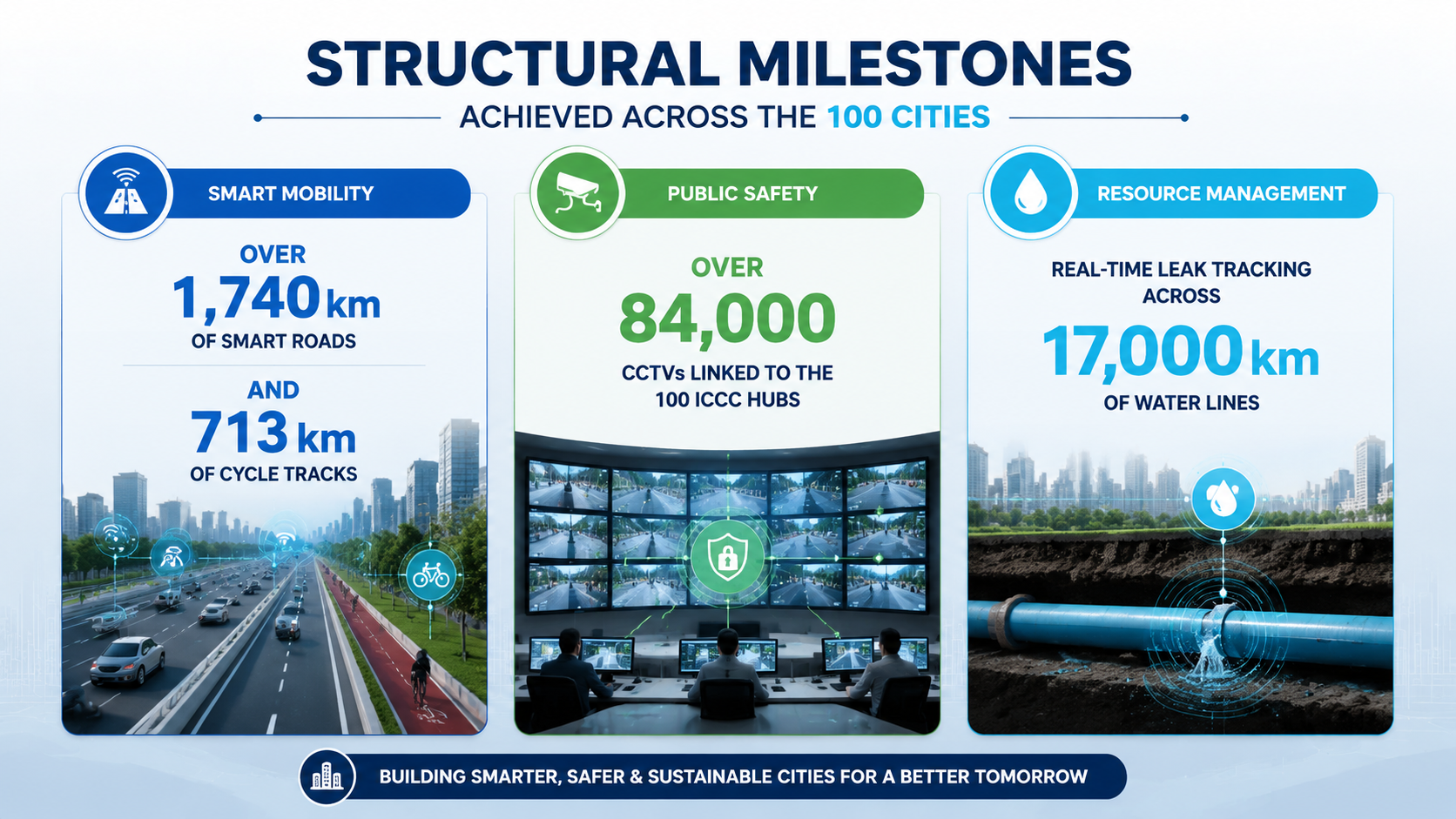
Finally, a shift is happening from tech-centric marketing to data-driven governance. Sensor networks detect water line ruptures, predictive algorithms optimize trash collection routes, and real-time traffic congestion is monitored using dynamic traffic lights.
These tools tackle immediate infrastructure deficits rather than just building abstract future worlds. The objective is to make cities viable, resilient, and functional — and this is what India’s Smart Cities Mission is all about.
It is a massive, real-world experiment, balancing digital ambition with basic civic survival.
What is India’s Smart Cities Mission?
India’s Smart Cities Mission — launched on 25 June 2015 — is an urban renewal programme by the Government of India that aims to develop 100 citizen-friendly and sustainable cities across the country. The main focus of the mission was to improve basic infrastructure, e-governance, and tech-based smart solutions to significantly enhance urban living standards.
The Programme and Budget Allocation
The programme received a total budget allocation of Rs. 47,652 crore ($5.38 billion) under the Union Budget. As of 31 March 2025, 99.44 percent of this budget amount has been disbursed to the 100 cities covered under the mission. After several requests from State governments, the Government of India has extended the deadline of the mission till 31 March 2025.
It is pertinent to understand how the process of selection was made before analysing its achievements. The selection process was designed as a multi-stage national competition called the Smart Cities Challenge, structured to reward reform-ready municipalities: The following are the three stages of selection filters applied to select the final 100 cities:
Stage 1 (State-Level Filter): The Ministry of Housing and Urban Affairs initially allocated quotas to states based on their urban population. State governments nominated a pool of potential candidates, which eventually included 110 nominated cities across successive rounds as states adjusted their priorities.
Stage 2 (The National Challenge): These 110 cities had to submit detailed Smart City Proposals (SCPs). They competed against each other on criteria like financial feasibility, citizen consultation, and institutional capacity.
Stage 3 (The Final Selection and Elimination): Over five rounds of intense screening between 2016 and 2018, low-scoring cities were weeded out. Some states also caused shifts; for example, West Bengal eventually pulled out of the mission entirely.
The Final 100: The screening officially closed when Shillong was selected as the 100th and final city in June 2018, locking the funded list to exactly 100 execution sites.
The main challenge thereafter was no longer administrative planning, as the final 100 cities along with their funding were in place; rather, the focus shifted to actual implementation. The massive funding became the foundation for the physical transformation of municipal landscapes, turning digital blueprints into tangible world class infrastructure projects.
Achievements so far
With the shift from planning to action, there has been a massive infrastructure overhaul in the urban areas of India. According to the comprehensive evaluation report released by NITI Aayog, the Smart Cities Mission achieved a massive 93 percent project completion rate across 8,063 projects, alongside 100 percent completion of Integrated Command and Control Centres (ICCCs).
This milestone was made possible by an operational sprint, which translated over ₹1.5 lakh crore of disbursed capital into functional smart solution across cities.
Conclusion and Way Forward
India’s Smart Cities Mission is the most ambitious development project for urban areas/cities. This mission started with massive budget allocations and many observers were initially critical and pessimistic about this urban renewal mission.
However, the “93 percent project completion rate” speaks to its success and effectively answers the critics.
The real challenge of the mission, however, lies in navigating three vital operational landscapes:
- Area-Based Development: Balancing the growth of advanced ‘smart enclaves’ with the infrastructure needs of neglected outer suburbs.
- Asymmetrical Regional Progress: Considering the fact that the high success rates are restricted only to specific top performing states.
- Local Capacity Limitations: Managing long-term maintenance budgets and skilling technical local staff to maintain complex technological solutions.
In conclusion, India’s Smart Cities Mission has shown that urban intelligence is not a final destination, but a continuous process of balancing high-tech ambition with everyday civic survival.