The Reserve Bank of India (RBI) last reviewed and announced the limits for financial accommodation extended to State governments and Union Territories on June 28, 2024.
RBI extends short-term liquidity support to State governments through the Ways and Means Advances (WMA) facility to manage temporary cash flow mismatches.
This time, the aggregate WMA ceiling for all State governments and UTs was revised, on January 9, 2025.
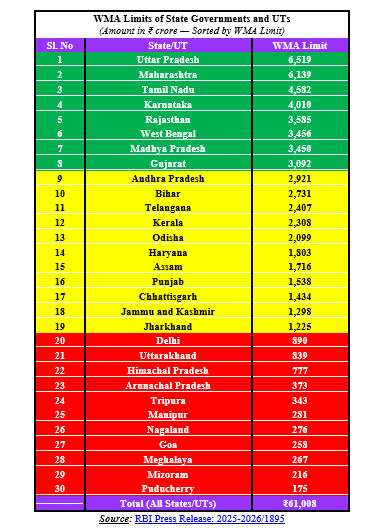
The specific state-wise WMA limits are detailed in an annexure to the official RBI circulars (which is placed at the end of the article). It is, however, pertinent to understand what WMA is, first.
What are Ways and Means Advances?
Ways and Means Advances (WMA) are temporary loan facilities provided by the RBI to Central and State governments to manage temporary mismatches in their cash flows. The WMA scheme was introduced in 1997 and is authorised by Section 17(5) of the RBI Act.
WMA and RBI’s Recent Policy Changes
The RBI manages short-term financial accommodation for State governments and UTs via the Special Drawing Facility (SDF), Ways and Means Advances (WMA), and Overdraft (OD) schemes to help them bridge temporary mismatches in their cash flows.
These facilities are fundamental to India’s financial management structure, allowing the government to function efficiently without resorting to more expensive market loans for immediate cash flow.
The terms and limitations are jointly established by the RBI and relevant governments, with periodic reviews based on economic conditions and expenditure data.
On June 28, 2024, the RBI had revised the total WMA limits for States and UTs, upward from the previous ₹47,010 crore to ₹60,118 crore, with effect from July 1, 2024.
This increase was based on recommendations from an RBI-constituted group that analysed recent state expenditure data.
On January 9, 2025, these aggregate WMA limits for all State governments/UTs were revised.
Following an agreement with the Government of the National Capital Territory of Delhi on January 5, 2026, the general banking business of GNCTD will be carried out by the Reserve Bank, starting from January 9, 2026.
The WMA limit for GNCTD has been set at ₹890 crore, resulting in a revised aggregate WMA limit for all State governments and UTs of ₹61,008 crore, up from the previous limit of ₹60,118 crore.
However, WMA is only a short-term solution and repayment within a short period may create additional pressure on the government’s finances.